The Anglo Dad's Summer Survival Guide to Israel
Long, hot, school-free summers — here's how to keep the kids happy and everyone cool.
The Anglo Dad's Summer Survival Guide to Israel
Two months. Sixty-two days. That's HaChofesh HaGadol — "The Big Vacation" — when elementary schools close from July 1 to August 31 and every Israeli parent enters survival mode. Where you come from, summer camp was a given and it rained sometimes. Here, it's 34° by 9am and the kids are home for nine weeks. This is your field manual.
Rule 1: The kaytana is not optional
A kaytana (summer camp) is how Israeli families survive July. Know your options:
- Municipal camps (kaytanot ironiyot) — run by your city, price-capped by law, registration through the municipality website usually opening May–June. The catch: subsidised hours typically end at 13:00. Yes, 1pm. Afternoons cost extra, if offered at all. Welcome to the great Israeli childcare cliff.
- Beit HaSefer shel HaKayitz — the heavily subsidised Education Ministry program for gan through grade 3, running most of July, Sun–Thu 8:00–13:00, for a token payment. Register via your municipality. Ministry info
- Private camps — sport, tech, art, everything. Budget roughly 2,000–2,300 NIS per two-week session. Popular ones open registration in late winter with early-bird deadlines around March. The Anglo rule of thumb: sort kaytana by Pesach or spend July improvising.
- English-friendly camps — Ramah Jerusalem Day Camp (built for English speakers, gan–6th grade), Camp Kimama (international vibe, day and overnight, including a Tel Aviv day camp in Park HaYarkon), and NCSY/OU programs for teens. Start with Nefesh B'Nefesh's summer camp guide and Fun in Jerusalem's camp roundup, then ask your local Anglo Facebook group — that's where the honest reviews live.
Rule 2: Respect the sharav
A sharav (you might hear hamsin) is the hot, dry heatwave that turns the country into a fan oven. The drill, per the Health Ministry and MDA: drink water constantly (even before anyone's thirsty), avoid sun and exertion between 10:00 and 16:00, SPF 30+ and hats on everyone, and never, ever leave a child in the car — not even for a minute, not even with the AC running. Your outdoor windows are before 10:00 and after 17:00. Midday belongs to the pool, the mall, or the mercy of your air conditioner.
Rule 3: Water is the answer to every question
- Splash pads (mitkanei mayim) — free municipal sprinkler parks are everywhere. Standouts: Teddy Park in Jerusalem (musical fountains, light show at night), Anaba Park in Modi'in, Kikar Ha'atzmaut in Netanya. Time Out's national splash-pad list is worth a bookmark.
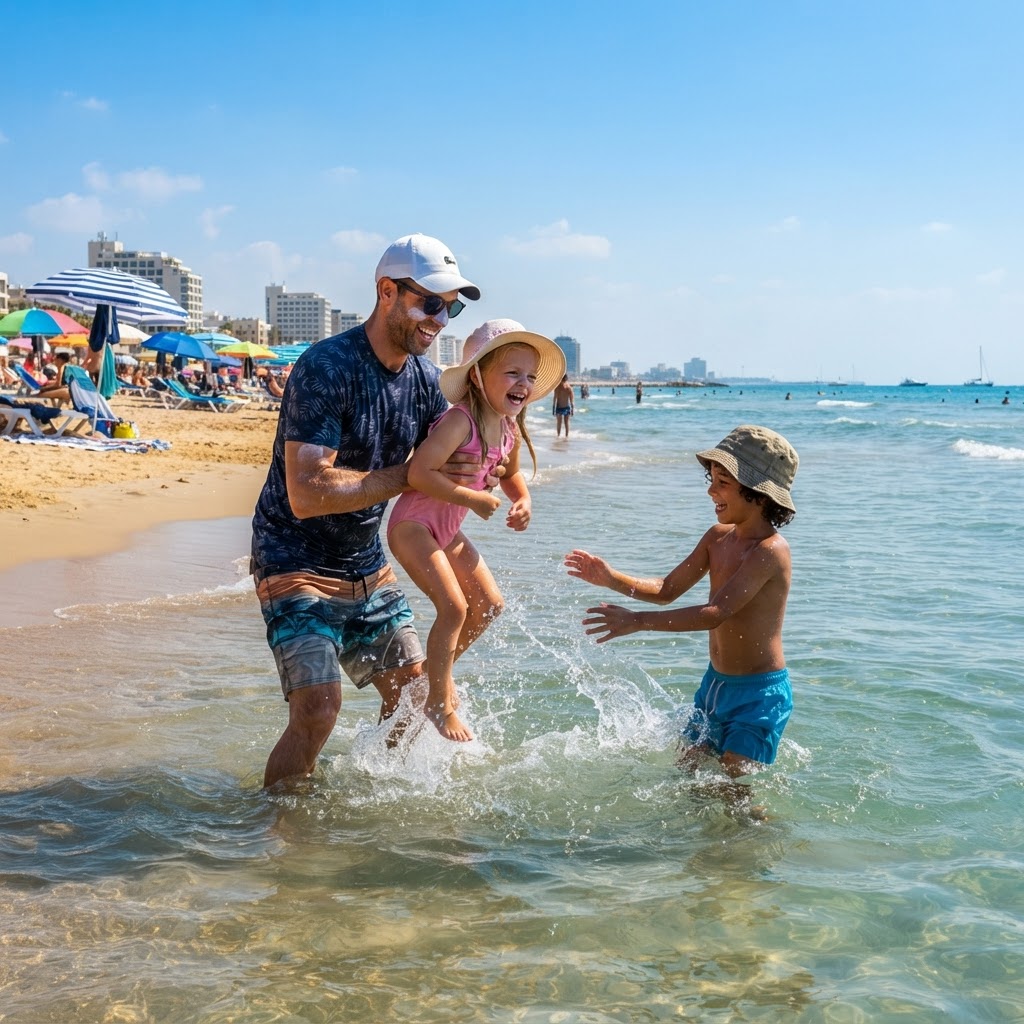
- Pool vs beach — the eternal Anglo debate. Beach is free, sandy and involves schlepping; the community pool (breicha) membership costs real money but has shade, lifeguards and a snack bar within crawling distance. Most families end up doing both and complaining about each.
- Water hikes — the great Israeli summer tradition of walking IN a stream. The classics: Majrase (800m of wading through a shaded stream — the best little-kids water hike in the country), Nahal Amud (shady Galilee stream with rock pools), Banias (Israel's biggest waterfall — look, don't swim), and Gan HaShlosha/Sachne (warm spring pools, lifeguards, brutal weekend crowds — go weekday morning). Book online at parks.org.il in summer; popular reserves hit capacity. Water shoes are not optional. Ein Gedi note: still partially recovering from flood damage — check the INPA page before driving to the Dead Sea.
Rule 4: The night shift
Israelis solved summer by moving it after dark:
- Shean Nights — a genuinely great after-dark sound-and-light experience in the Roman ruins of Beit She'an, ~300 nights a year, reservations required.
- Zoo evenings — the Jerusalem Biblical Zoo runs summer hours and night tours when the nocturnal animals actually do something.
- INPA summer nights — sunset and night events across reserves in July–August: English activity calendar.
- Jerusalem in August — the Hutzot HaYotzer arts festival at Sultan's Pool and the Train Theater's Puppet Festival; check the municipality's summer events hub for dates.
- Free A/C honourable mentions: mall play areas (Israel21c's big kids' summer list) and the Israel Museum's free kids' activities, including English story time on Thursdays.
Rule 5: Learn the food canon
Summer here has an official menu. Artik — the generic word for ice pop, available at every makolet, and the currency in which children are bribed. Melona — the watermelon-flavoured pop that is, objectively, the king of the freezer. Avatiach im gvina — cold watermelon with salty Bulgarian cheese, which sounds wrong and tastes like victory. And the mangal — the low-slung charcoal grill around which Israeli park culture revolves. Your induction is complete when you've fanned coals with a piece of cardboard for forty minutes while insisting you have it under control.
Rule 6: Lower the bar
Nobody's kids are enriched for 62 straight days. The locals' actual formula: kaytana until 1pm, pool or splash pad, artik, screen time during the hot hours without guilt, something outdoors after 5pm, repeat. The kids will remember the watermelon and the stream hikes, not the Pinterest schedule you didn't make.
The survival checklist
Kaytana booked (by Pesach next year — you know this now). Water bottles in every bag. Water shoes for everyone. SPF 30+ applied before the whining starts. Parks reserved online before schlepping north. Freezer stocked with artikim. Mangal, coals, and unearned confidence. Sixty-two days. You've got this.
Event dates and camp prices shift year to year — verify before booking, and check parks.org.il for current reserve status.